
Prime Minister Modi and President Xi held the conversation on Wednesday on the sidelines of the BRICS (Brazil, Russia, India, China, South Africa) summit in Johannesburg.
Speaking at a virtual conference of the World Economic Forum, the external affairs minister, at the same time, said the border row happens to be one part of the larger issue of how India and China adjust to each other when both are rising.

A deft hand on India-China relations, Bambawale earlier handled the China desk at the MEA.

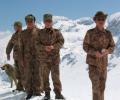
Xi asked about their condition and whether they were able to "receive fresh vegetables" in the inhospitable terrain.
'They also agreed that for the overall development of bilateral relations it was essential to maintain enduring peace and tranquillity in the border areas,' the MEA said in a statement.
The Indian Army has been pitching for a faster disengagement process in areas like Hot Springs, Gogra and Depsang to bring down tension in the mountainous region.

The remarks of White House Press Secretary Jen Psaki came ahead of the 14th round of military-level talks between India and China on the 20-month row in eastern Ladakh.

Army chief General Naravane said the ongoing dialogue will sort out all the perceived differences between the two countries.
The focus of the deliberations was on finalising modalities for disengagement of troops in eastern Ladakh.

'We hope the Indian side will work with the Chinese side towards the same goal, keep up close communication through military and diplomatic channels, and ease the situation and reduce the temperature along the border'

The incident had taken place at a time when the Indian Foreign Minister, S Jaishankar, was in Moscow for the Shanghai Cooperation Organisation meeting, where he met his Chinese counterpart to address the border issues.

The Indian Army on Friday strongly insisted on early disengagement of troops by China from all the friction points in eastern Ladakh at the eighth round of corps commander-level talks between the two sides that primarily focused on a roadmap for restoration of peace and tranquillity in the region, according to people familiar with the developments.

We strongly urge India to take practical steps to correct its mistake, Wu said.
The Indian side is expected to present specific proposals at the talks to deescalate tension in Pangong Tso, Galwan Valley and Demchok -- the three areas in eastern Ladakh where the two sides have been on a bitter standoff for last one month, the sources said.
The former army chief-turned-minister did not provide any evidence to support his statement. He said China historically never accepted any war casualties including in the 1962 conflict with India.

His attack on the government came a day after Defence Minister Rajnath Singh assured Parliament that India has not conceded anything in the sustained talks with China and it will not allow even an inch of its territory to be taken away by anyone.

"China's position on the Zangnan region (South Tibet) is consistent and clear. We never recognised the so-called Arunachal Pradesh," Chinese Foreign Ministry spokesperson Hua Chunying told a media briefing while responding to a question.
Jaishankar said China, in violation of the 1993 and 1996 agreements not to mass troops on the Line of Actual Control, chose to do so, and added that its attempt was obviously to unilaterally change the LAC.
Gen Wang is the fourth commander to head the Western Theatre Command after the eastern Ladakh standoff began in May last year.

Makki is a US-designated terrorist and brother-in-law of Lashkar-e-Tayiba chief and 26/11 mastermind Hafiz Saeed.

India and China on Friday are holding another round of high-level military dialogue to resolve the 22-month-long standoff in some friction points in eastern Ladakh, two months after the last round of such talks failed to yield any significant outcome.
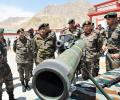
The Army has significantly bolstered its fire power along the frontier with China by deploying a range of rockets and artillery weapons and plans to procure an array of additional systems, including 100 K9 Vajra howitzers and UAVs, to augment combat prowess.
Experts have said the economic cost of China's misadventure in the last couple of months in eastern Ladakh and South China will be "massive" as it has "exposed" Beijing's "real face" when the entire world is fighting coronavirus.
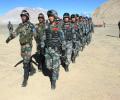
During the course of the intense and complex negotiations between senior commanders of the two armies that ended at 2 am on Wednesday, the Indian delegation also apprised the Chinese PLA about the "red lines" and conveyed that the onus was largely on China to improve the overall situation in the region, the sources said.
Even senior Indian officials have openly stated that Chinese troops did not enter into the Indian territory, Wang said.
China's Ambassador to India Luo Zhaohui said "the ball is in India's court" and it was for the Indian government to decide what options could be on the table to resolve the standoff.
There was no official word on the outcome of the talks.

The US president previously offered to mediate between India and Pakistan, a proposal rejected by New Delhi which maintains that there is no role for any third party in bilateral issues.

The last round of Corps Commander-level talks had taken place on October 12 but there was no breakthrough on the disengagement of troops from the friction points.
As the border standoff entered the sixth month, an early resolution to the row appeared dim with close to 100,000 Indian and Chinese troops remaining deployed in the high-altitude region and showing readiness for a long-haul. There is no official word on the talks yet but sources said the agenda was to finalise a roadmap for disengagement of troops from all the friction points.

India is looking forward to a "constructive" dialogue with China to resolve issues in remaining friction points in eastern Ladakh, sources in the security establishment said on Monday ahead of the 14th round of military talks between the two sides on the 20-month row.
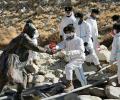
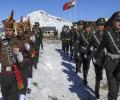
India and Chinese troops on Saturday exchanged sweets and greetings at 10 border posts along the Line of Actual Control (LAC) including in eastern Ladakh to mark the New Year, officials said.

Singh, in his address to the Indian-American community in San Francisco, also sent a subtle message to the United States that New Delhi does not believe in a diplomacy of 'zero-sum game' and its relationship with one country cannot be at the expense of the other.
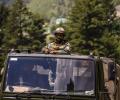
He said that following a build-up of troops, multiple transgressions and attempts to unilaterally change facts on the ground by China, there have been several levels of talks and a fair amount of communication to ensure that the matter can be resolved through negotiation and diplomacy.

The marathon fourth round of Lt Gen-level talks also focussed on steps for pulling back large number of troops and weapons from rear bases along the Line of Actual Control in eastern Ladakh.

The NSA particularly highlighted the need for resolving outstanding issues as quickly as possible and talked about the need for maturity and sincerity in dealing with the issue.

Singh, accompanied by Army Chief Gen Manoj Pande, also carried out a comprehensive review of India's military preparedness along the Line of Actual Control (LAC) in Arunachal Pradesh and lauded the troops for guarding the border with "unwavering commitment and unparalleled courage."

Maritime resources will be key to sustained growth and development of nations across the Indian Ocean Region (IOR) in the ongoing century, he said delivering his keynote address at the IOR Defence Ministers' Conclave held on the margins of Aero India-2021, India's premier defence and aerospace show.

Nepal said it was confident that both its "friendly neighbours" India and China will resolve their border stand-off at the Line of Actual Control through peaceful means.
In a written reply to a question in Lok Sabha, Minister of State for External Affairs V Muraleedharan gave a brief account of the four-month-long standoff and said the Chinese side attempted to transgress the Line of Actual in several areas of the western sector since mid-May.
